

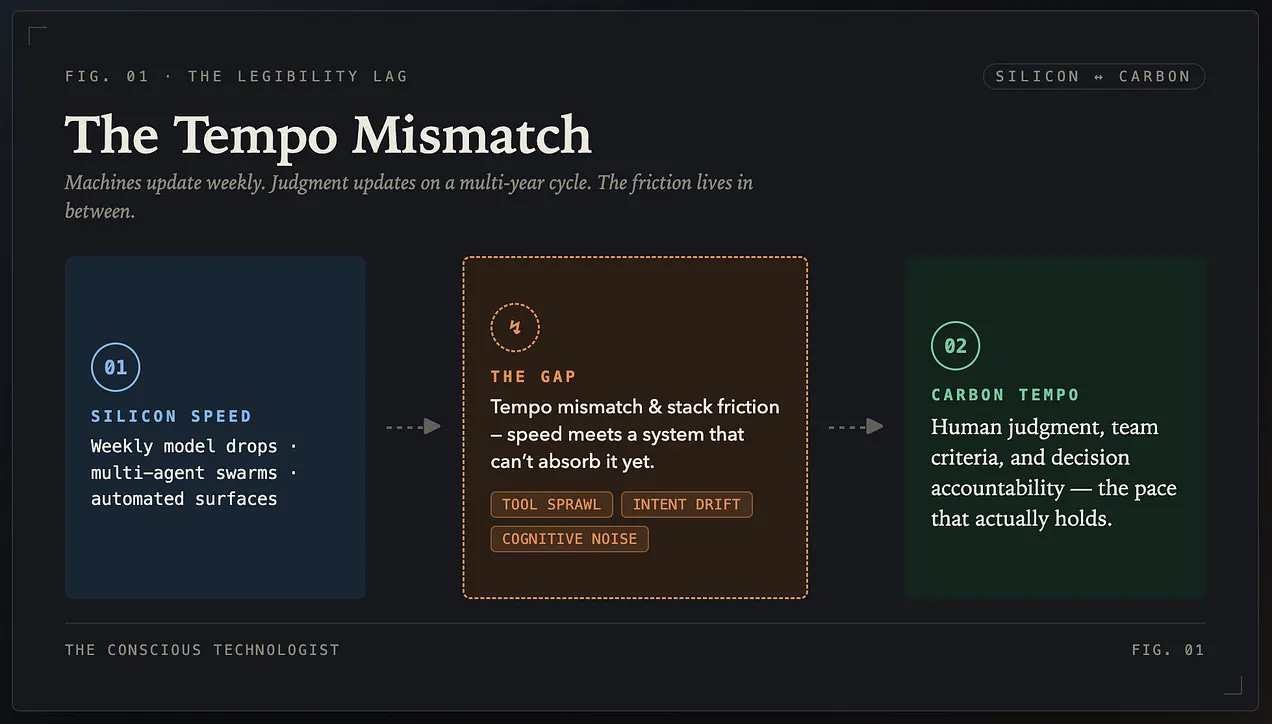
What held in the field of the conscious technologist this week was a clear acknowledgment of tempo mismatch.
Case in point: these specific new AI models dropped on the market — 0xAlpha and Qwen 3.8-Flash. Real capability. But the reflex on X for the untrained? More pressure to adopt it now, before you’ve even mapped whether it fits how you actually work. That reflex is the tempo mismatch at the macro level.
And so while public feeds continue obsessing over weekly AI model drops and autonomous agent swarms, people on the ground are hitting a different wall: artificial silicon speed versus natural carbon tempo.
When model capability updates every few days, but human judgment, organizational habits, and decision criteria update on a multi-year cycle, you don’t get instant transformation. You get stack friction — like in our figure 1 image at the beginning of this newsletter.
Adding another surface or autonomous agent on top of an unexamined workflow doesn’t speed up output. It simply increases cognitive noise, which will manifest as small migraines or tension headaches.
From the Desk
On LinkedIn this week, we looked at Sam Altman’s recent admission that GPT-4 didn’t flip software businesses overnight. The economy has inertia because human systems run on carbon time.
When your digital environment accelerates while your decision architecture remains static, the drag you feel isn’t a personal productivity failure. It’s an architectural mismatch.
Read the breakdown: Silicon vs. Carbon Speed
From the CT Academy
📗 New course released: AI Foundations for Conscious Technologists
LLM and AI fundamentals, plus the hidden layers shaping cognition and consciousness. Built for CTs specifically — not another generic prompt course. Members get a discount. Enroll now ↗👨🏫 Live this week:
[Workshop] Find Your Holistic AI Marketing Agent (Aug 28) — Friday. Aligning your AI marketing stack without losing agency. Register ↗
[Guest Talk] Guidance Beyond Language: Wisdom, Embeddings & LLMs (Sep 1) — a member on guiding LLMs. Register ↗
From the Community
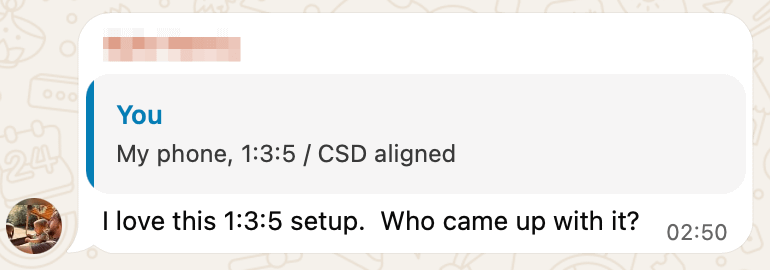
Over in our community, one member saw another member share their 1:3:5 setup (which is part of the Conscious Stack™ framework we teach), but applied to the apps on their mobile phone. Just another example of how simple mental models can have compounding impact over time.
We also had a question about prompting. Some mentioned that I prompt very differently to others, and were interested in the idea of getting live prompt training.
This Week’s Action: Find Your Drift
You don’t need another app to see where your stack has crept out of alignment. You already carry the data.
Open your Screen Time app (iPhone: Settings → Screen Time; Mac: System Settings → Screen Time) and look at your top apps this week.
Ask one question of each: Did I consciously choose this, or did it choose me?
When getting started with conscious stack design, the tools eating the most time are where your attention is being designed back at you.
That’s the drift — the gap between the stack you think you run and the one actually running you.
Want to go deeper?
Map it → If you’ve never laid out your stack deliberately, start at consciousstack.com.
Automate it → Want the drift surfaced for you? Take our free quiz — it helps you find out what type of conscious technologist you are, based on your current stack setup.
Until next time — watch your tempo, not just your tools.
— Siosi
PS. Reply and tell me: which app surprised you most in your Screen Time this week?