

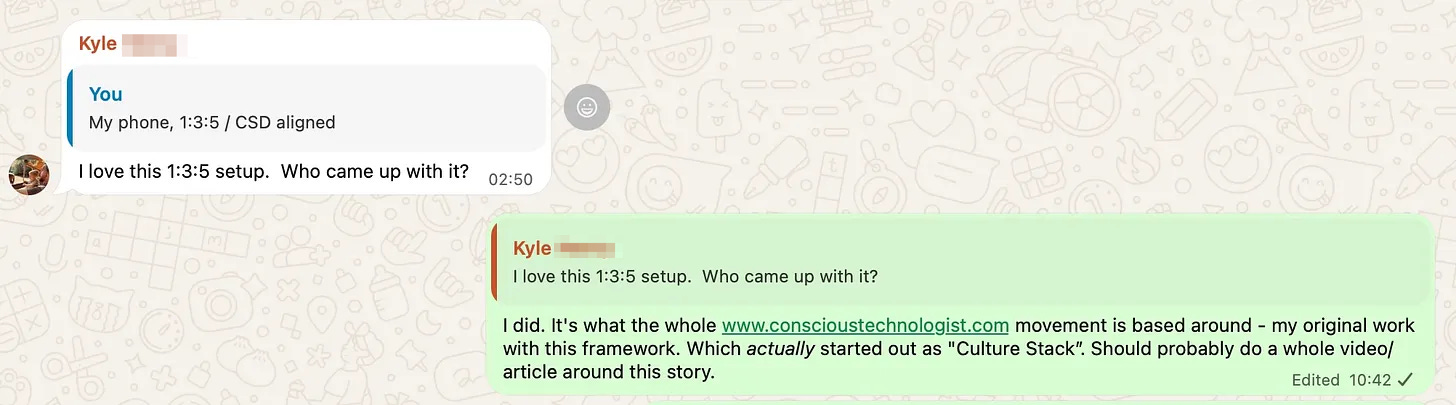
A member of our community, Kyle, asked a simple question in our group recently: who came up with “1:3:5?”
First, if you’re new here, the 1:3:5 rule is what we use when teaching conscious stack design (the art and science of designing your tech stack, consciously, so you stay in control of your attention, agency, and awareness — in the AI era and beyond).
Second, this question from Kyle prompted me to dive deeper into the story for newcomers, since the whole Conscious Technologist (CT) movement sits alongside this simple geometry. But it didn’t start out as a productivity rule, and it certainly didn’t start with those numbers, in that order.
It started as something called “Culture Stack.”
The Backstory: Culture
In 2016, I was helping a traditional tech company, IRESS, move onto Slack, Zoom, and Jira. The tools were not just collaboration software. They changed how people talked, what got remembered, and what the culture actually was. Around the same time, I kept meeting founders and operators drowning in 30+ apps, switching context every few minutes, unable to tell me where their source of truth lived.
That was the first observation: your stack is not neutral. It is a mirror of how you think, and a quiet architect of how a group behaves. In the individual level, it expresses personal identity (or what’s truly driving behavior). At scale, it manifests through culture (the dominant expression of a collective’s identity).
So, Culture Stack was the first form of the work — read an organization’s culture from the tools it already used, instead of another survey. Then the work kept moving. Culture became “Conscious” (intentional awareness of the tools), because people kept associating culture as just HR. What I was building was not just about HR.
The stack stopped being a catalog and became an intentional constraint, with very real hidden influencers. Because, after 15+ years dealing with change management across company stages, the real problem was never “which tools.” It was the 10+ tools around the one being looked at, which often provided me with the better context for the problem (much like how AI birthed “context engineering” over simply “prompt engineering”).
The Geometric Formation
The first usable law was originally 5:3:1. Five supporting tools, three active, one anchor. Start with the sprawl and compress down to a single source of truth. That is how I was auditing stacks. Hierarchical. Distillation-focused. It worked. Teams could finally answer “where does this live?” without opening seven tabs.
But then I started teaching it.
People did not remember it as 5:3:1. They kept referring to it as “1:3:5.” What is your one anchor? What are the three you actually touch every day? What five can stay specialized without becoming dependencies, but support? I spent enough time at the intersection of people and tech, to know when not to fight emergent language or behavior. That’s how humans build coherent systems (and how things go “viral”).
So, I went with it. I adapted the same pyramid but in two directions. 1:3:5 is how you assess. 5:3:1 is how you audit (at the technical level). Expand, then distill. Which formed a healthy open-close pattern for the Conscious Stack framework.
So I distilled the full sequence into the Pingala Handshake Protocol (for the more technical among you), which you can find as a usable Skill on GitHub here.
When Language Caught Up
The rename stuck because it matches how people were explaining it to others. Start at the apex. Move down. One intent, three active supports, five that hold the base. Nine slots.
I did not sit down one afternoon and invent this framework finished. I watched tool sprawl for over 15+ years, across each tech wave, named the constraint geometrically, and then let real user behavior flip the sequence. The geometry was already there, the language simply caught up.
If you have been using 1:3:5 and wondered where it came from: that is the story.
Next Steps
Ready for a 1:1 stack audit? Book a session (suitable for business owners / senior leaders)
Not yet ready, but want to try building your own stack? Try our free tool
PS. Stay tuned for our bi-weekly review issue, coming out this week.