

You reach for the tool before you reach for your own thought. The thought was there — half-formed, yours — but the tool or device got there first. You don’t remember when that started. You just know it’s happening.
That moment is where this all starts. The fracture is simple: your tools keep you moving (subconsciously), when what you really need to do is stop and think. Two movements have shaped how people think about technology and wellbeing, in response to these behavioral shifts for humanity:
→ Digital wellness — Cal Newport coined the philosophy in Digital Minimalism (2019): delete apps, go analog, reclaim attention. Subtraction as the prescription. It helped people question their screen habits. It didn’t tell you what to do with the tools you actually need for work.
→ Tech ethics — Tristan Harris, then a design ethicist at Google, went viral in 2013 with a presentation calling on tech companies to respect users’ attention. That became the Center for Humane Technology (2018), which lobbies Meta, Google, and lawmakers to change how platforms are built. Their work targets systemic design. It doesn’t target your stack.
Both matter. We leave their work to them. But we work on the micro: how you architect the tech stack you live inside day-to-day. So while tech ethicists try to get the big companies to change how they influence you, or while digital wellness practitioners get you to change your habits, you (as a CT) simply change the shape of your stack.
🟪 The Biological Imperative
Before we go further, there’s an even deeper shift taking place that influenced our CT movement: human biology is increasingly being treated as infrastructure. Attention, behavior, nervous systems, cognition — all are now surfaces to be optimized, routed, monetized, and automated around. If cognition has become infrastructure, consciousness is next, if it isn’t already being treated that way:

This is why the CT movement exists: to help the people who can sense this shift prepare for what’s coming consciously, not reactively. Our mission is to find and train 144,000 conscious technologists by 2030 — humans capable of building, choosing, and embodying technology without surrendering their inner sovereignty.
The CT movement has its home at ConsciousTechnologist.com for now, but there are many pieces to the puzzle that will be forming over time. Here are four things that make us different.
🟪 From Digital Minimalism to Coherence
The old advice: disconnect, delete your apps, go analog. That’s the digital minimalist philosophy. Useful for a time, but the reality is that people end up needing to back to work using the latest tools or technology. Research on technology overload shows that adding tools past a certain point produces diminishing returns. Each new tool adds more cognitive cost than value.
The new path: bridge, rearrange your apps, align your stack geometry. Modern society nudges people towards extremes and polarity. The biggest flex today is finding your own “middle path” and sticking to it, regardless of what the outside world tries to push on you. It’s not necessarily about adding more or doing digital detoxes. It’s about finding your own digital equilibrium, and sticking to it.
Our core framework (the Conscious Stack™) assumes your tools aren’t going back in the box. The goal is improved coherence over pure productivity: tools that actually help align your life, instead of consume it against your will.
🟪 The 1:3:5 Rule
Your working memory holds about seven things at once (Miller’s Law, 1956). Every time you switch apps, it costs about 23 minutes to refocus (Gloria Mark, UC Irvine). Harvard Business Review (2022) found knowledge workers toggle between apps 1,200 times a day — spending roughly 4 hours a week just reorienting after switches.
The 1:3:5 Rule of the Conscious Stack™ works inside those limits:
1 Anchor tool
3 Active tools
5 Supporting tools
Nine slots. You design your stack to fit your nervous system, not the other way around. Defaults train you. So you design them.
🟪 Conscious Stack Audits
The Center for Humane Technology focuses on how companies like Google build. We focus on how you build your immediate digital environment. Forbes calls it “digital tool fatigue”: the erosion of mental health and productivity from managing too many tools. Faros AI’s 2025 study of 10,000 developers found AI tools increase individual output but not company productivity. The overhead cancels the gain.
In 1:1 Stack Audits, our coaches review every tool you run, cut the redundant ones, check what data they take, and decide how AI enters your workflows, within the geometry of a 1:3:5 conscious stack.
🟪 In Practice: Freeman’s Stack
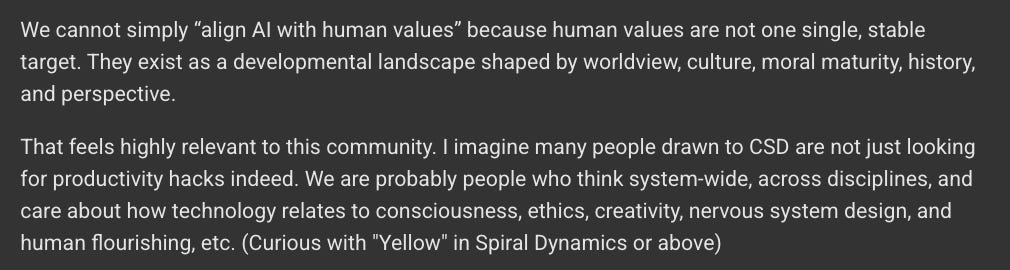
Freeman Fung — speaker, author, and MindValley coach — found out about CT through another member of ours, Jazmine Ross. He was already deep in Integral Theory and Spiral Dynamics — thinking across disciplines about how technology relates to consciousness. But he realized he was living inside a stack he hadn’t consciously designed.
After a 1:1 Stack Audit, Freeman wrote about how he saw Conscious Stack Design as a “practice of meta-alignment:” aligning tools with values, nervous system, creative work, and purpose. He shared his story at a CT meetup. Then he became a Founding member.
In his own words:

🟪 The Conscious Technologist
This movement is attracting all types — from 11 year olds all the way up to 80 year olds — builders, coders, engineers, and knowledge workers on a self-exploration path who feel frustrated by modern tech/AI culture. Our CT Lab and local gatherings help people move people from passive use of tech, to more conscious architecture.
A Conscious Technologist (CT) is someone who uses tech more consciously, or aspires to. Intentionally, daily. Who inspires others around them to do the same through embodiment. Who remembers they are human, even when the tools or technologies cease to.
If you’ve ever ended a day on your laptop and felt like you moved through everything but arrived at nothing, you’ve experienced the fracture already. Tech/AI defaults are training you. The question now is, what are you going to do about it?
What’s one tool in your current tech stack you keep meaning to cut, but haven’t? Why or why not?